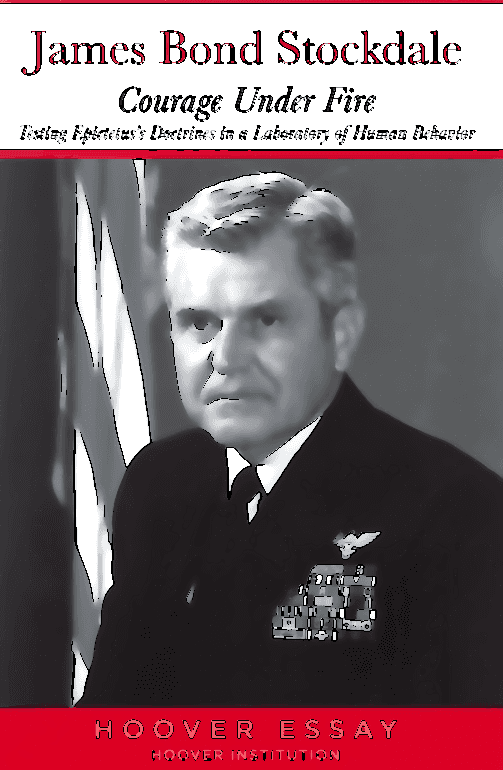
Courage Under Fire
Testing Epictetus's Doctrines in a Laboratory of Human Behavior
James Bond Stockdale
1993
View authorCourage Under Fire is a brief yet deeply powerful work in which James Stockdale puts the philosophy of Epictetus to the test in what he calls a “laboratory of human behavior”: his own experience as a prisoner of war in Vietnam.
The book is neither an academic treatise nor a simple memoir. Instead, Stockdale shows how Stoic doctrines—especially the distinction between what depends on us and what does not, the mastery of assent, prohairesis, and conditional acceptance (hypexairesis)—can be applied under extreme conditions of suffering, deprivation, and violence.
Its central claim is radical: the true value of a moral philosophy is revealed by its ability to hold when everything else collapses. Deprived of freedom and subjected to torture and isolation, Stockdale explains how Epictetus’s thought enabled him to preserve moral integrity, dignity, and a sense of duty, even when all hope of rescue or success had vanished.
The “courage” at stake is not heroic in a spectacular sense, but inward. It is the courage to maintain sound judgment, to refuse inner consent to humiliation, fear, or despair, and to continue acting in accordance with what one judges to be right, regardless of consequences.
Originally delivered as a lecture, the text is marked by sobriety and rigor. Stockdale neither idealizes Stoicism nor romanticizes his own experience. He presents Epictetus not as a philosophy of consolation, but as a demanding discipline—one capable of sustaining a human being when everything else has been stripped away.
Courage Under Fire is now regarded as one of the most powerful contemporary testimonies to the practical relevance of Stoicism. It shows that ancient concepts are not abstractions, but living tools, capable of shaping a coherent moral conduct even in the most inhuman situations.