mmmarcus
Articles & programsMeditationsQuotationsConceptsAuthorsBooks (public domain)TimelineMapQuizzesKey learningsBooks (for reference)About
Changer le thème
FrançaisEnglish

hello@mmmarcus.com|@mmmarcus|2026

Back to authors
Zeno of Citium

Zeno of Citium

PhilosophyStoicism
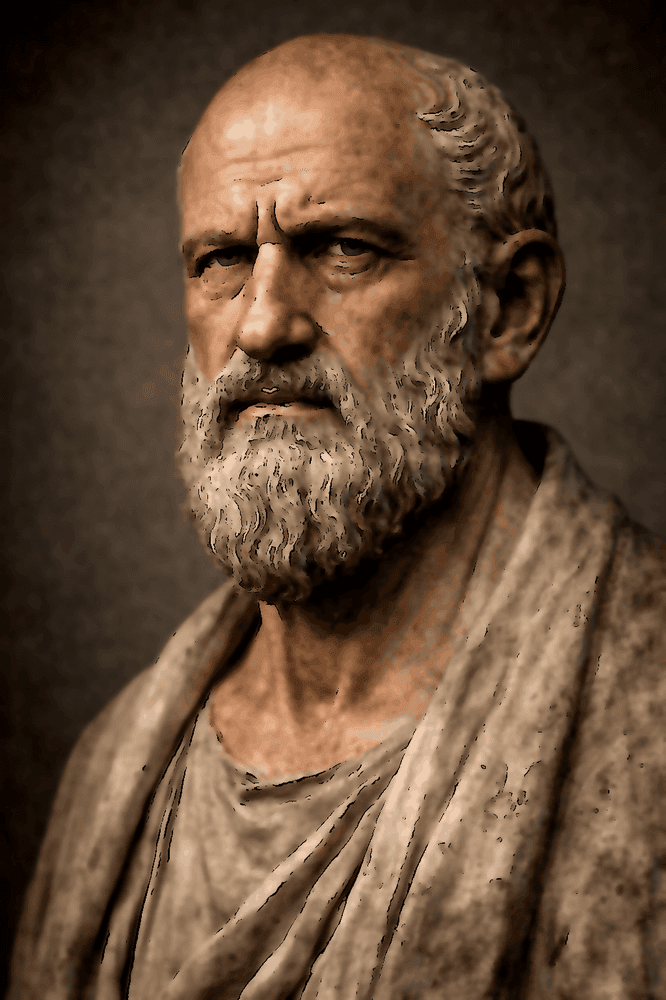
Zeno of Citium (c. 334–262 BCE) was the founder of Stoicism. A Cypriot philosopher who settled in Athens, he developed a doctrine that conceived philosophy as a way of life grounded in accordance with reason and nature. Teaching at the Painted Stoa (Stoa Poikilè), Zeno laid the foundations of a system uniting logic, physics, and ethics, in which wisdom consists in living in harmony with the Logos, the rational principle that structures the cosmos. His thought emphasizes moral autonomy, the mastery of passions, and virtue as the only true good. Although his writings are lost, his influence is decisive, shaping the entire Stoic tradition from Chrysippus to Epictetus, Seneca, and Marcus Aurelius.

Thoughts (7)

←Previous
|
→Next
|
ESCBack
A bad feeling is against reason and nature

A bad feeling is against reason and nature

A bad feeling is a commotion of the mind repugnant to reason, and against nature.

Zeno of Citium

as quoted in Tusculanae Quaestiones by Cicero, iv. 6

Wisdom is in the world itself

Wisdom is in the world itself

If melodiously piping flutes sprang from the olive, would you doubt that a knowledge of flute-playing resided in the olive? And what if plane trees bore harps which gave forth rhythmical sounds? Clearly you would think in the same way that the art of music was possessed by plane trees. Why, then, seeing that the universe gives birth to beings that are animate and wise, should it not be considered animate and wise itself?

Zeno of Citium

as quoted in De Natura Deorum by Cicero, ii. 8

The goal: to live in agreement with nature

The goal: to live in agreement with nature

(The end is) life in agreement with nature.

Zeno of Citium

as quoted by Diogenes Laërtius, in Lives of Eminent Philosophers, "Zeno", 7.87: “This is why Zeno was the first (in his treatise On the Nature of Man) to designate as the end ‘life in agreement with nature’ (or living agreeably to nature)...”

Death is not an evil

Death is not an evil

No evil is honorable; but death is honorable; therefore death is not evil.

Zeno of Citium

as quoted in Epistles No. 82, by Seneca the Younger

Listen more, speak less

Listen more, speak less

The reason why we have two ears and only one mouth is that we may listen the more and talk the less.

Zeno of Citium

as quoted in Diogenes Laërtius, Lives and Opinions of Eminent Philosophers, vii. 23

Happiness is a flow

Happiness is a flow

Happiness is a good flow of life.

Zeno of Citium

as quoted by Stobaeus, ii. 77

The universe is rational

The universe is rational

That which exercises reason is more excellent than that which does not exercise reason; there is nothing more excellent than the universe, therefore the universe exercises reason.

Zeno of Citium

as quoted in De Natura Deorum by Cicero, ii. 8; iii. 9