Back to articles
14 / 80
6 min.
Stoicism: foundations
What's outside you: your fourth circle: the flow of events
Things that happen have nothing to do with you.
Things that happen have nothing to do with you.
There is a line that opens one of the greatest classics of Chinese literature, The Romance of the Three Kingdoms. A simple sentence that contains the entire history of the world:
“The empire, long united, must divide; long divided, must unite.”
There is something deeper in this cycle than a mere historical observation. It is an image of a world in motion, a breath of History itself. Nothing lasts. Not even what once seemed unshakable. Empires, their stone foundations, their laws carved in marble, their armies, their flags, their anthems, and yet, simply by existing, they begin to crumble. Slow to rise, slow to fall, but mortal all the same. Greatness invites fragmentation, fragmentation calls for new unity… until that too begins to crack.
And it’s not just about distant kingdoms or vanished dynasties. It’s everywhere. In your own life too.
What you build, no matter how solid it feels today, will one day bear the marks of time. What you lose today, no matter how painful, can become a foundation again tomorrow. What you think is fixed shifts in silence. And what you see collapsing may be nothing more than a prelude to renewal.
Everything changes.
Everything passes.
Even what claims to be eternal.
To those first three elements outside of you, other people, the past and the future, and the involuntary emotions we explored in earlier texts, a fourth must be added: the course of events. This current into which your life is drawn, which you do not choose, but to which you can respond.
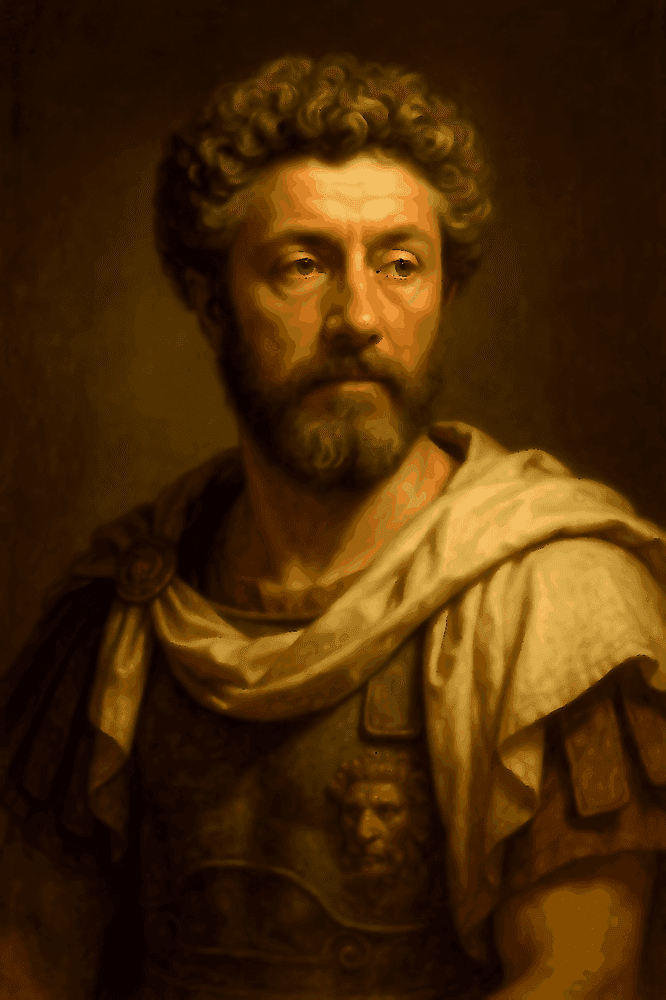
Marcus Aurelius, himself at the head of a vast empire, was not deceived. He knew that what appears solid is only a moment in the flow. He saw this same principle at work not only in the affairs of kingdoms, but in the very fabric of life. The empire too, he was essentially saying, is carried away by the river of becoming:
“There is a kind of river of things passing into being, and Time is a violent torrent. For no sooner is each seen, than it has been carried away, and another is being carried by, and that, too, will be carried away.” 1
And:
“Repeatedly dwell on the swiftness of the passage and departure of things that are and of things that come to be. For substance is like a river in perpetual flux, its activities are in continuous changes, and its causes in myriad varieties, and there is scarce anything which stands still, even what is near at hand; dwell, too, on the infinite gulf of the past and the future, in which all things vanish away.” 2
What you cherish today will vanish tomorrow, and what weighs on you now will also fade. Pleasures and sorrows, plans, wounds, hopes... all of it drifts in the current. Nothing remains fixed; life never stands still.
It is caught in a ceaseless flow, a perpetual motion of events that repeat, that change shape, but always return in new forms. The flow of events is not a poetic idea or a convenient metaphor. It is the raw reality in which your entire life is immersed. Everything around you, everything you feel, everything you believe you hold in your hands, all of it is already changing, right now, as you read these lines. You never live the same moment twice. Heraclitus, whom we’ve already spoken of, said it himself:
"You never bathe in the same river twice."
You never breathe the same air twice.
The world is constantly changing, with every heartbeat, every sunrise, every spoken word.
It’s not you who chooses what happens.
Things occur. They come to you without warning, without asking for your consent, like waves rolling endlessly over the sea. You can’t stop the current. You can’t tell it to wait, or to slow down. You can fight it, exhaust yourself trying to hold on to what’s fleeting, or you can learn, as the Stoics invite us to do, to recognize this movement as the very texture of life, and understand that you, like all of us, are in the river, but you are not the river. Things happen, but they are not you.
You are, rather, the clear-eyed witness who sees the shapes pass by, and who learns, little by little, to stop clinging to them.
But if you are not these things, you may ask, then what can you truly call “you”?
We’ll come back to this in more detail, but for today, remember this: every human being is made up of three parts:
a body;
a soul, that is, the sensitive, living part;
and a ruling principle, your intellect, your reason, that spark within you that can judge, choose, and give meaning.
Your body?
It’s carried along, like a branch in the river. You can’t stop it. You can’t pull it out of the current.
Your soul?
It feels, it trembles, it hopes, it protests. It too is swept by the movement of things.
But your ruling principle…
your true self… that can remain standing. It is the only thing you truly own. The part of you that can say yes or no. The part that can look at the apparent chaos and refuse to panic. That can say: I accept, or, this doesn’t concern me, or, here is how I will respond to this. This ruling principle is a central pillar of our philosophy, and I’ll be talking to you about it in more depth over the next ten or so articles.
The course of events is outside of you, and you cannot slow it down, but you can choose how you enter it, how you take part in it, and with what posture.
Yes, you will at times be struck by emotions, fear, desire, sorrow, they will pass through you like wind through the branches. But that wind doesn’t have the power to uproot you.
People often say that destiny is what must happen.
And the Stoic, the one you are becoming, does not deny destiny. On the contrary, they see in it the acceptance of all things, and they learn to walk with the flow of events, not against it. They learn to adjust their gaze, to align their own will with that of Nature, with that universal Reason that governs the world, even in the midst of apparent chaos.
And that, {{username}}, is where your true freedom begins.
See you very soon.