Back to articles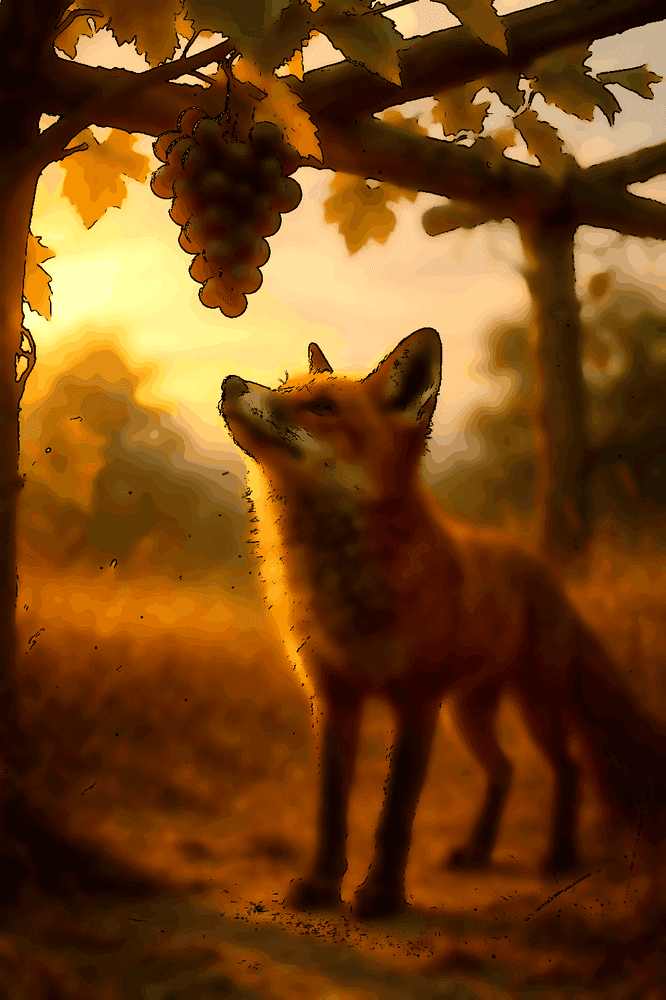
10 / 25
8 min.
4 min.
Tales and Stoicism
The Fox and the Grapes
The sweetest fruit is found not in what we obtain, but in how we handle what we cannot
The sweetest fruit is found not in what we obtain, but in how we handle what we cannot
Once upon a time, in the heart of a lush vineyard, a rather confident fox was out for his usual stroll. The sun was shining, the breeze was light, and all seemed right with the world. That is, until his sharp eyes spotted something glorious: a bunch of plump, juicy grapes hanging from a vine. These weren’t just any grapes—no, they were the kind that made your mouth water just by looking at them, the perfect shade of ripe purple glistening in the sunlight.
“Well, well, well,” said the fox, licking his lips. “Today’s my lucky day. Those grapes will make the perfect snack.” You know, foxes always appreciate a bit of sophistication in their diet.
They’re not just hunters, they’re connoisseurs.”
He trotted over to the vine, poised and ready for a feast,with all the confidence of someone who’s about to land the best meal of their life.
There was just one small problem: the grapes were hanging much higher than he had anticipated. Undeterred, the fox stood on his hind legs and stretched as far as he could. But no luck. The grapes remained just out of reach.
“Hmph,” he muttered, a little annoyed now. But giving up? Not a chance. After all, he was the clever fox, known for his wits and cunning. Surely, a bunch of grapes wouldn’t get the better of him. So he took a few steps back, ran forward, and leapt into the air, jaws snapping—only to land empty-mouthed on the ground.
Not one to be disheartened, the fox tried again. This time, he took an even longer run-up and jumped with all the power his legs could muster. But alas, the grapes still dangled above him, mocking his every attempt.
Frustration began to creep in. The fox, now panting and slightly humiliated, stared up at the grapes with narrowed eyes. How dare they! After another failed jump—and another—the fox finally sat down, exhausted, and stared at the fruit that had so thoroughly eluded him.
But then, something shifted. His clever mind began to work in a different way. A grin curled up on his face as he stood up, dusted himself off, and declared loudly, “You know what? Those grapes are probably sour anyway. Not worth the effort. I don’t even want them.”
With his dignity back intact—or so he thought—the fox turned on his heel and trotted away, head held high, pretending not to care about the grapes that had so clearly defeated him. And as he disappeared into the trees, the grapes, still glistening in the sun, hung there, untouched and as sweet as ever.
~
"The Fox and the Grapes" is just a simple tale about sour grapes, right ?
Let’s peel back the layers a bit, shall we? From a psychoanalytical perspective, this story illustrates a classic case of denial. The fox, faced with the painful frustration of not being able to satisfy his desire for the grapes, copes by convincing himself they weren’t worth it in the first place. It’s a defense mechanism—an attempt to protect his pride from the sting of failure. We all do it in some way when reality doesn't align with our desires.
From a social psychology standpoint, it’s a textbook case of reducing cognitive dissonance. The fox, confronted with the uncomfortable tension between his desire for the grapes and his inability to get them, shifts his mindset to regain some control over the situation. Instead of accepting the grapes were out of reach, he reframes the problem entirely: “The grapes must be sour.” In this way, he shifts the blame from his own limitations to the grapes themselves.
Now, what does all this have to do with Stoicism? Quite a bit, actually. Stoicism teaches us that we don’t control external events—like the height of those grapes—but we do control how we perceive and react to them. The fox's mistake was not in failing to get the grapes, but in how he handled that failure. Rather than calmly accepting that some things are beyond his reach, he let his ego get in the way, resorting to denial instead of embracing the truth with grace.
A true Stoic approach would be to acknowledge the situation as it is—sometimes, the grapes are simply out of reach. There’s no need to twist reality to protect our pride or make excuses. The fox could have walked away content, knowing he gave it his best shot, and that the grapes simply weren’t meant for him. Instead, he let frustration cloud his judgment and reframe the situation to fit a narrative that shielded him from discomfort.
In life, there will always be "grapes" beyond our reach—things we want but cannot have. The Stoic lesson here is that it’s not the loss or the failure that defines us, but how we choose to respond to it. The fox, in this case, didn’t fail because he couldn’t reach the grapes; he failed because he couldn’t accept that truth without inventing a story to protect his ego. And in doing so, he turned what could have been a moment of clarity into one of self-deception.
So, the next time life dangles something just out of reach, don’t let frustration or pride sour your perspective. Accept it with calm, learn from it, and move on with integrity. Because in the end, the sweetest fruit is found not in what we obtain, but in how we handle what we cannot.