
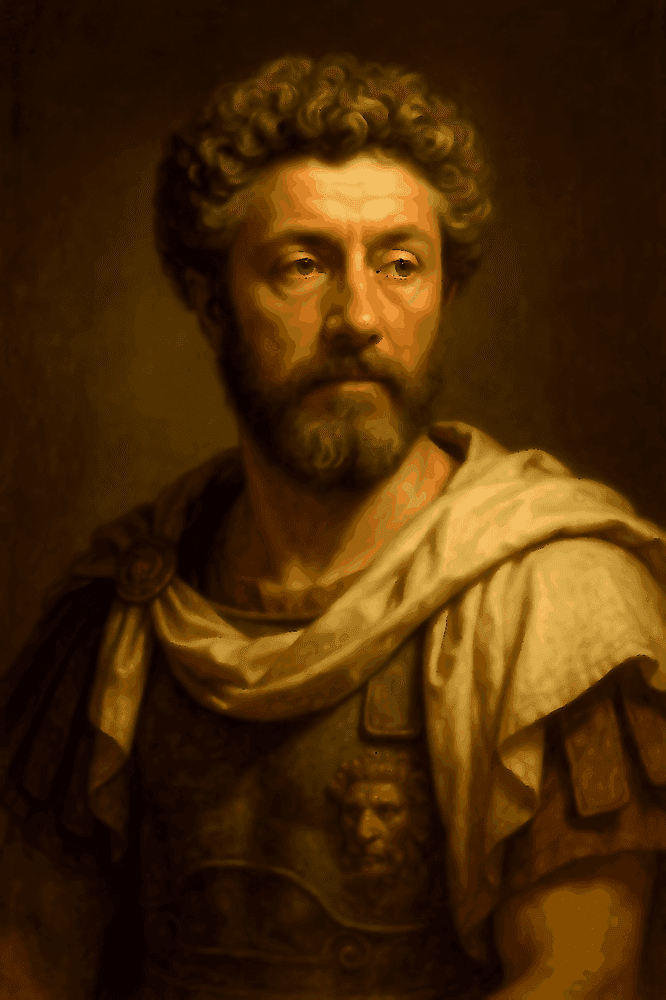
The three fundamental principles I will talk about in this and the next two lessons are the most important {{username}}.
These three principles stem from the understanding of your place in the universe that we saw in the previous lesson.
These three principles are the structuring framework that Stoicism offers us.
They are your holy trinity.
These three principles should ring like mantras in the heads of philosophy students. Let me tell you: if you're in this course with me to change the way you think, to learn how to control what is going on up there (in your head), if you really want to take control of your thoughts, then you owe it to yourself to embed these three principles deep within you. Let them take the first place on the ladder of your thoughts, buried beneath your flesh and radiating within you like magma bursting with incomparable energy that secures the whole - your being, its unity; forged around an indestructible core. A core that nothing can shake. Like the effervescent, eternal heart of the sun, these mantras nourish your inner strength, your energy, your resilience, your peace of mind and your constancy 1. When you're one with them, you become invisible, nothing can touch you. Yes, you'll be sad sometimes, because you aren't made of stone 2, you're a rational animal and as such you feel things, and that is normal. However, if you live by these principles, if you have made them your personal religion, you'll not allow these feelings to take root and ruin your life.
So, if you really want to live by these principles, you have to know them by heart, they have to become second nature to you. Each of your actions, each of your thoughts, must become an incarnation of these three principles.
These three principles are:
1/ You can't control everything that happens to you, but you can control how you react to it.
2/ Distinguish between what depends on you and what doesn't.
3/ Accept that change is a constant in life.
So much for the introduction to the three lessons that follow.
Now, let's take a look at the first of the three main principles:
~
Epictetus:
“It is not things that trouble us, but the judgment we make about things.” 3 .
This sentence is certainly one of the most important and best known of Stoicism. It summarises the essence of an entire system and brings you back to a fundamental idea: it's your thoughts, your judgments, the way you perceive an event that disturb you. And even if you cannot change the course of events that we commonly refer to as "life", you can control how you react to them.
The first principle is:
You have to look at your life as a series of events over which you don't always have control, but you can control your reaction to these events.
The other way around: you have no control over the sequence of events that make up your life, but you can control your reaction to these events.
— That's quite obvious mmmarcus. I know that when I look out the window and see that it's raining, I have no control over it.
— Have you ever complained that it's raining because you wanted to have a barbecue in the garden with friends, for example?
— Of course I have!
And that is precisely the problem. Why mess with something you have no control over. It makes no sense. It's raining, it's raining. Maybe you'll meet up with your friends inside and you'll have a great time. May be the atmosphere will even be conducive to confidences, to the more intimate moments of laughter that the atmosphere inside creates. Or maybe you'll call the whole thing off and spend a pleasant moment with your partner - a special time that maybe you and your partner really needed at that moment.
I know, that's a lot of "maybes."
But they're meant to tell you that all possibilities can lead to happiness. Whatever the event is.
Event: Sunshine today? Cool, you can barbecue as planned.
Event: Rain today? Too bad for the sun, you'll find a nice alternative.
Your judgment remains constant.
You aren't insensitive, but you're moderate.
Some people take this for granted, and that's a good thing, because it means they have the foundation for a stoic approach to their daily lives.
Obvious, you may say.
And yet.
How many of us want to control everything?
How many of us want to explain everything?
The circumstances in everyone's life are the result of the Universal Reason.
Call it fate,
cosmic law,
the Nature of the Whole,
or just don't call it at all. Find the name that fits your idea of the world.
In the face of this fate, the unique, liberating power we all possess - you or anyone else on Earth - is the control you can exercise over your thoughts, over your response to the events nature throws at you.
According to the Stoics, there are four such reactions, irrational emotions or "passions" as the ancients called them: pain, fear, craving and pleasure. We'll come back to them in more detail later.
This control is your salvation.
Your absolute weapon.
When you control your thoughts, it eases the pain of your soul. It is the only thing that truly empowers you.
Imagine you're alone on your boat,
on the open sea.
The sea is calm and enveloping.
You've just caught a fish and are enjoying it grilled on the back deck of your little boat. But you've barely had time to enjoy this moment of simple happiness when the sky darkens in the distance. You have just enough time to get ready before the storm hits. Faster than you can imagine, the sea rages, the waves crashing over you, threatening to capsize you at any moment. You cannot stop the fury of the water, nor can you change the nature of the elements, which mean you no harm, but are simply there, in all their power and indifference.
What can you do then?
Freeze yourself?
Prepare yourself for death?
Or decide not to panic, keep your cool, and make the decisions that could save your life.
Your life, you, your mind,
is the person on that boat.
External events,
the sea in front of you.
Sometimes gentle and pleasant, sometimes threatening.
This is the outside world.
This is the Universal Reason which manifests itself under your eyes.
In your daily life, storms of all kinds come your way, you know that, right? Gusting winds like hurricanes: the loss of a job, a relationship that breaks up, an illness that knocks on your door.
A wise person once told me: "Life is chaos", which isn't exactly a Stoic idea, but let's admit it for today.
It's up to you to prepare yourself as best you can for that chaos. We'll see that throughout this program, but know that you already have the power to deal with things by accepting that you cannot control everything, that not everything depends on your will, and by practicing to exercise that control.
This is the most fundamental teaching of Stoicism.
“The soul of a man does violence to itself [when it] turns against anything that comes to pass, [which] is a separation from Nature.” 4
When a painful event occurs, do not be overcome by despair or anger, but look beyond the circumstances you cannot control and focus on what is truly in your power: your inner reaction. In these moments, practise keeping your mind calm and collected. Take a step back, look at the situation from a broader perspective, which often helps put things in perspective, and use your {{username}} intelligence to find the best way forward.
You can choose to see the challenges you face as opportunities to learn and grow, and work on them.
You can choose not to let your inner state be dictated by external circumstances, but to work on it.
You can choose to be strong, resilient and wise, and work on that.
~
This learning is not like a Candy Crush game or a bar of instant chocolate.
Wisdom is not innate.
It is the result of a personal investment.
Anyone who masters a specialty has had to devote long time learning it. A cabinetmaker, a mountain guide, a chef, a famous writer ... they've spent years or even decades honing their skills. They experiment and update their personal body of knowledge as they learn, be it in a workshop that smells of sawdust or on a mountain trail.
Learning Stoicism is also a long-term process.
It is not necessarily complex, but demands time. It takes time for your mind to gradually, and at its own pace, internalize a certain number of concepts that need to steep like a good tea before they can be savored.
Those who strive to become wise will only reap the rewards of their labor if they are truly invested in their work, driven by a deep aspiration. To become a better being.
Be the craftsman of your thoughts.
Take the time to learn, as all good craftsmen do.
Soon you won't have to think about how to control your thoughts, you'll do it instinctively.