I've talked to you, in previous articles, about the importance of staying in the present moment. About that ability to return, again and again, to the instant we're living. I've also spoken to you about the need to contemplate death — not to fall into despair, but to restore the true value of each moment.
And yet, today, I want to talk to you about hope.
Maybe you're here right now, weighed down by a dull sadness. You look at your life and all you see are cracks. Professionally, you feel stuck. In your love life, there’s either emptiness or misunderstanding. Your friendships are fading, your family feels distant, even when they’re near. You watch the hours slip by, without a single ray of joy. And you tell yourself: I should be able to control my thoughts, I should be doing better. But you can't. Not today. Not yesterday either.
Everything feels blurry. Your thoughts crash into each other. One moment, you feel like a conqueror, ready to turn everything around. The next, you give up, resigning from your own life. As if something inside you quietly broke.
And you wonder: am I losing my mind?
No, {{username}}, you're simply alive.
This inner chaos isn’t a sign of failure. It’s a sign that your soul is still fighting. That your mind, even in confusion, refuses to fall asleep. You’re not broken. You’re just passing through the storm.
So stay with me for a moment. Breathe. And look at this inner chaos not as an enemy, but as a place to learn. Because even in the darkest night, there is still one thing you can hold on to: your faculty of judgment. That small space within you, sometimes so small you think it’s gone, that can still say: “I don’t understand everything, but I choose not to give in to panic.”
That’s where hope begins. Not in grand promises of change, but in this simple choice: to remain standing, today again.
In moments like these, {{username}}, there is a remedy. A quiet, ancient, powerful remedy. It’s rarely spoken of in Stoic circles, perhaps because, at first glance, it seems to contradict the ideal of detachment that this philosophy promotes. But that’s just on the surface, because Stoicism, when you look closely, is far more nuanced than some would have you believe.
This remedy
is a particular kind of inner impulse: a waking dream, a lucid yet luminous
projection.
The image of a better future.
But be careful, {{username}}: the dream must nourish you, never consume you.
It’s not
there to pull you away from the present, but to bring color back to it. It
promises nothing, guarantees nothing. But it awakens something in you. A light
joy, a flicker of desire, the shadow of a smile. It’s your mind reaching out,
exploring what could be. And suddenly, your horizon opens. You find yourself
thinking: What if…?
What if things could change?
What if what I’m living through today isn’t an ending, but a threshold?
What if tomorrow—or ten years from now—something gentler, truer, greater is waiting
for me?
Maybe that dream won’t come true. But that’s okay.
And like a self-made enchantment, you suddenly find yourself fueled by a new energy. A desire to move, to act, almost to conquer. Your mind, until now clouded by confusion, lights up with a clear impulse.
And almost naturally, you catch yourself thinking: Alright, I have this dream… but how could I make it real?
And that,
{{username}}, is the true purpose of these couchside daydreams.
They’re not there to lull you to sleep, but to spark something in you. To fan
the flames of right desire, of vital impulse. The dream serves only this: to
feed your will to act, to gently, yet firmly, tip you back toward movement. Because
for a moment, it gave you the strength to keep going. It reminded you that your
life is not defined by what you feel right now. And that within you lies an
untouched capacity—to hope, against all odds.
There’s
also a second, subtler function: without even realizing it, your stress eases. The
weight that was crushing you a moment ago suddenly feels lighter, because your
mind just performed a powerful shift.
You’re no longer consumed entirely by your immediate worries.
You’ve replaced them, if only for a breath, with the image of a possible
future, one that’s greater, more open.
And that simple shift in perspective can change everything.
But then—you might ask—isn’t all this in contradiction with Stoic teaching? To dream, to project, to desire… isn’t that drifting away from the present? Isn’t that opening the door to disappointment?
No.
This dream
isn’t an escape.
It’s not a demand placed on the world.
It’s an invitation extended to yourself. A call to mobilize, not to depend. Because
as long as you don’t tie your happiness to the exact fulfillment of that dream,
it can become a tool, an ally, a lever. That’s what it means to dream like a
Stoic: To imagine the future without clinging to it. To use it to live the
present more fully, not to run away from it.
The Stoics of antiquity didn’t see hope itself as a vice. What mattered, what still matters, is how you use it. Hope can be a dangerous illusion if you wield it to escape reality, to refuse to see things as they are. In that case, yes, it pulls you away from virtue, it weakens you, and the ancients would have warned you against it. But if that hope, instead of blinding you, grounds you more deeply in reality—if it brings forth a genuine aspiration within you, a will to act justly, to restore your inner balance, then it becomes a force aligned with the Stoic spirit. The sages of the past would approve. They would approve of you using it to nourish your capacity to choose consciously, to move toward what is good.
For a long
time, {{username}}, I searched for the connection between Stoicism and hope.
And everywhere I looked commentaries, analyses, interpretations… I kept running
into the same verdict: hope is the antithesis of Stoicism. A trap for the weak
soul, an illusion to be cast out, an expectation turned outward. In short,
everything a sage should avoid.
But I never truly believed that.
And then one day, I found the story I had been looking for. A story that allowed me to reconcile two forces that many claim are incompatible. A story that, even today, serves as my inner justification. A personal justification, but one I’m sharing with you, {{username}}, so you can see if it resonates with you too.
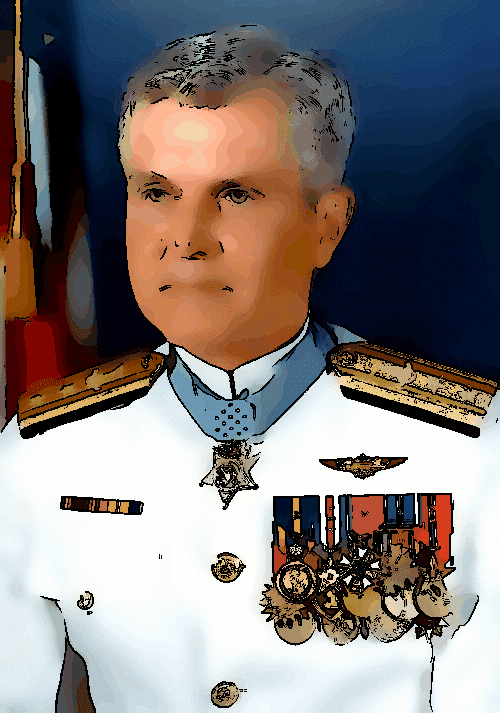
That story is the story of Admiral James Stockdale.
A man whose life was tested in the most extreme way, and who, at the heart of that trial, chose to put Stoicism itself to the test, so to speak. His story gave rise to a paradox that now bears his name. It’s also a living, embodied response to that tension between hope and lucidity. It shows, with rare clarity, that hope, far from being a weakness, can become a strength, provided it’s rooted in reality. And that sometimes, what we see as opposites are merely illusions of the mind: we pit Stoicism against hope, just as we might pit fire against light—forgetting they can spring from the same flame.
The story I’m about to tell you is true.
It doesn’t come from an ancient book or a philosophical treatise, but from a flesh-and-blood man who embodied Stoicism in one of the most inhuman places imaginable.
James Stockdale was a vice admiral in the U.S. Navy during the Vietnam War. Before donning the uniform, he had studied Stoic philosophy, especially Epictetus. It wasn’t out of curiosity, but as an inner discipline, a preparation for hardship.
On September 9, 1965, at the age of 42, he was leading an airstrike over North Vietnam. His plane was hit and shot down. He ejected but severely injured his back and knee upon landing. Captured immediately, he became a prisoner of war.
Thus began a living hell that would last seven years.
Seven years of captivity. Of repeated torture. Of prolonged isolation. Of deprivation, beatings, starvation. Seven years with no guarantee he would ever make it out alive. No contact with loved ones. No horizon. Nothing but a cell and the daily brutality of his captors. And yet, Stockdale did not break. On the contrary, he became a beacon for the other prisoners. He comforted. He inspired. He protected. He endured. A quiet, unshakable strength. He organized secret communication between cells and structured the silent resistance.
Many of his fellow captives didn’t survive. They weren’t weak, these men were seasoned soldiers, hardened by war. But the lack of perspective, the endless stretch of time, the constant postponement of promised release… eventually broke something essential inside them. Stockdale saw this. He watched men fade from within. But he held on to one thing: a deep, almost visceral conviction that he would one day return home. He didn’t know when, or how, but he believed that day would come. He clung to it not like one clings to a date, but like one clings to an inner axis. He didn’t feed on blind optimism. He didn’t spin comforting stories, because he knew tomorrow could be worse than today, that his captors’ cruelty could escalate, that death could come at any moment, without warning. He knew all of this, and he accepted it. He faced those truths head-on.
But he held
his course.
He would repeat to the others, tirelessly: “We’re going to make it out. But
it won’t be quick, and it won’t be easy.” Day after day, he kept that quiet
fire alive, a calm, clear-eyed hope that depended on nothing and no one.
And it was
this ability to hold, at once, a firm hope and total lucidity that left its
mark.
That marked history. And that gave rise to what we now call the Stockdale
Paradox.
In 1973, seven years after his capture, James Stockdale and his fellow prisoners were finally released following the Paris Peace Accords. He came home. Alive. Physically broken, but standing tall in spirit.
He had held
on.
He and his comrades had endured.
And the Admiral’s name would go down in history.
~
That, {{username}}, is what Stoic hope looks like.
A hope
without dependence. Without escape. Without imposed deadlines. Stockdale never
tied his hope to external circumstances. He didn’t say, “I hope my captors
will show mercy,” but rather, “I hope to remain dignified no matter what
they do.”
He hoped to return home yes, deeply. But he never allowed that hope to
become a demand. He remained the master of his inner response, no matter what
happened.
And that,
{{username}}, is the lesson I wanted to share with you.
Hope is not the enemy of Stoicism. Illusion is. The refusal to see things as
they are, yes. But to hope without lying to yourself, to hope without
conditions, to hope while looking truth square in the face… that, to me, is not
only compatible with the teachings of the Stoics, it may be one of their most
beautiful expressions. Because it reconciles two seemingly opposing ideas.
So if one
day you find yourself doubting,
if you feel that hoping is a luxury for the naïve, or a betrayal of your
commitment to live in reality… think of Stockdale. And remember that there are
men who have walked through hell without giving up their humanity, precisely
because they knew how to hold on, deep within, to a lucid kind of hope.