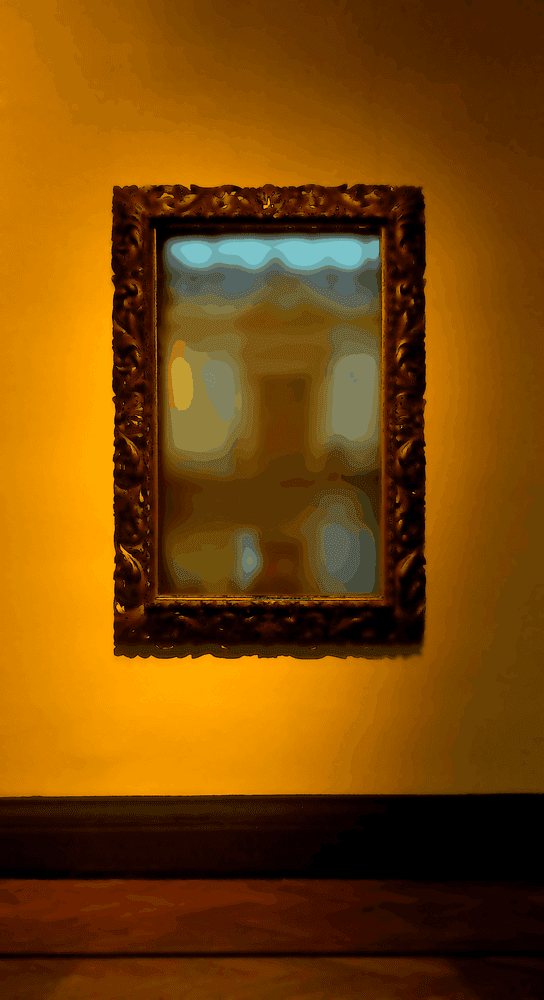
Picture yourself staring at your screen, scrolling through the news. One moment, you see an alarming headline: 'The world on the brink of chaos.' The next, a success story about a good-looking guy or a gorgeous woman who made their first million at 25. Then comes your Instagram feed, packed with extreme contrasts.
Without even realizing it, you've fallen into a frame of reference dictated by algorithms.
And insidiously, this imposed way of thinking can fuel your anxiety.
If every time you open your phone or YouTube on your TV, you see millionaires living in penthouses in Dubai or hear hateful rhetoric against people who are, in the end, your brothers—regardless of their skin color or religion—your mind is being projected and trapped inside a box. A box with thick, reflective walls that do nothing but magnify and distort reality, blinding you to everything outside of it.
Gregory Bateson was an English anthropologist of the last century. He spent his career studying the human sciences, focusing in particular on frames of reference (framing in English) that shape our perception of the world.
I think the philosophers of antiquity would have appreciated his work. What Gregory Bateson taught us is this: we do not perceive raw reality as it truly is, stripped of our own influenced interpretation. Instead, we see reality through frames, through filters. And these frames are not neutral. They shape our perception of the world, of ourselves, and of others.
One of the most studied effects is the way the media gradually shape our frames of reference through the constant reinforcement of partisan narratives. When the media present current events, they don’t simply report facts—they provide an angle, an interpretation, a story. It’s not just a report on the economy; it’s a crisis. It’s not just a political development; it’s a scandal. These frames act like invisible lenses, forcing you to see the world through a specific prism: that of the journalist, who has their own perspectives; that of the TV network, which, by amplifying the drama of the story, seeks to boost its audience—and therefore its profits; that of the network’s owner, who follows their own agenda, perhaps with political ambitions in mind.
These frames are a distortion of reality.
If you are constantly exposed to alarmist narratives, you will develop an anxious view of the world, where every event seems like a looming threat—even when those events may have little to no impact on your daily life.
If you are bombarded with endless displays of success (real or not?) from strangers on the internet—people who, at 25, have seemingly achieved more than you would even dare to dream—you may unconsciously start seeing this as the norm, something forever out of your reach. And before you know it, you start seeing yourself as a failure.
If a particular topic is always presented as an endless war between two irreconcilable sides, you will be tempted to pick a side—even when the reality is far more complex and nuanced than it appears.
The real question isn’t just “What are you reading?”, but “Through what frame is it being told?”
And let me continue with another situation that Gregory Bateson illustrated so well in his work:
You’re told
that staying informed is a civic duty.
But the information available is biased, anxiety-inducing, and manipulative.
If you distrust the media, you’re labeled a conspiracy theorist.
If you accept their framing, you risk being influenced without even realizing
it.
This is the very trap that Bateson described as the “double bind”—a situation where, no matter what you choose, you lose. The double bind traps you in a loop with no way out: whatever choice you make, it feels like the wrong one. And that’s precisely how confusion takes hold of your mind. When doubt settles in — just as much as blind belief would—you become vulnerable, and vulnerability breeds anxiety.
Take the media, as we’ve been doing in this article: they frame, filter, and select. But if you look closer, this analysis applies to many aspects of life. Your own mind, for instance—when you feel good or, on the contrary, when you feel low. Is your perception rational? Or is it a distortion imposed on you by your frame of reference? When you talk with friends and your opinions clash, isn’t it simply the result of different frames of reference — ones that, by their very nature, oppose each other? In the end, isn’t it just a question of values that don’t align?
So,
{{username}}, what can you do?
Where is the line between healthy skepticism and paranoia?
Faced with this, what would the Stoic in you say? It would remind you that the only thing you truly control is how you interpret things. Not the media. Not the narratives imposed on you. But the frame you choose to adopt in response to them.
That’s exactly why I turned to philosophy, you know—because it offers me a frame. I could have chosen another. In the end, everything comes down to frames of reference, at least in my view. And we, as Stoics, have chosen a frame that upholds rationality and virtue as the only true sources of happiness.
We could have chosen a different one. Buddhism, existentialism, materialism—any school of thought that resonated with who we are at the deepest level. But it is Stoicism that we chose. It’s not necessarily better—although, if we’re being honest, we’d have to acknowledge that little part of our ego that believes it is—but it is the one that spoke to us. So we follow this frame because it seems right.
And this very Stoic frame constantly brings us back to the true value of things. That’s why I’m talking to you about Gregory Bateson’s concept of frames of reference—because these invisible frames that come between us and reality distort our ability to see things for what they truly are. But recognizing the existence of these frames, naming them, is already a huge step forward.
Step one:
knowing they exist.
Step two: understanding how they work.
Step three: integrating that knowledge and living with awareness of their
presence.
So,
rather than absorbing a message as it is,
ask yourself: what is the underlying frame? What idea is being planted in my
mind? Is it neutral, or does it serve a particular interest? Rather than being
trapped in this game—the double bind—remember that you can always step out of
it by redefining the question itself.
The Stoics never asked us to withdraw from the world, despite what many mistakenly believe about wisdom. On the contrary, the Stoic lives at the heart of the city, fully embracing their role in society and practicing virtue. Unlike the Epicureans, who sought tranquility in secluded communities, away from the chaos, the Stoic stays engaged. But to live peacefully within the city, one must understand its workings, its laws — including the law of frames of reference.
And so,
I invite you, my friend, not to be a prisoner of the narratives imposed upon
you.
The world
is neither in ruins nor perfect.
It simply is.
It follows a universal order — remember that.
Your task
is to step outside the frame,
to see beyond it,
to take back control of your perspective.
Because the one who chooses their frame of thought also chooses the way they
live.