Back to articles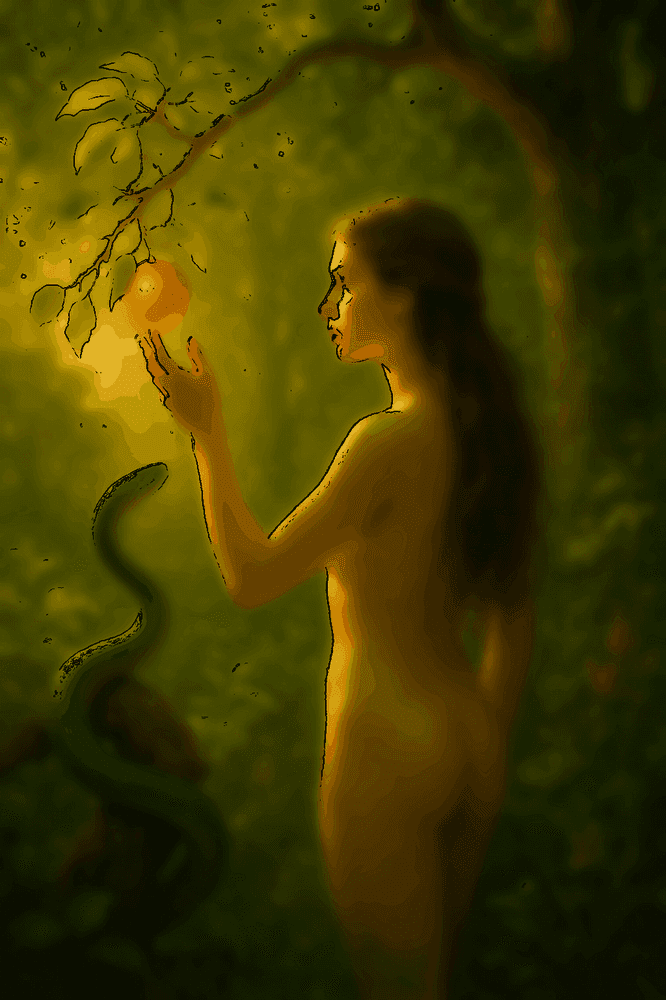
13 / 25
11
4 min.
Tales and Stoicism
Eve and the Forbidden Fruit
The tension between desire and discipline, curiosity and contentment
The tension between desire and discipline, curiosity and contentment
Today, we’re diving into one of the oldest and most well-known myths in the world: the story of Eve and Adam. It’s a tale of curiosity, temptation, and the search for knowledge, all set in the fabled Garden of Eden. At its core, this ancient story captures a timeless truth about human nature and desire—a truth that has sparked countless interpretations over the centuries. Let us recall today that story, rediscovering again how the lessons in this story might guide us toward wisdom, acceptance, and contentment. So let’s step back into that lush paradise, and see what unfolds when knowledge and temptation take center stage.
Imagine, if you will, a garden more beautiful than any place you’ve ever dreamed of—a paradise, untouched by time, where everything seemed to glow with an almost magical light. In this garden, every color was more vivid, every scent more intoxicating. Rivers ran as clear as crystal, twisting gently through groves of towering trees, each bearing fruit that seemed to shimmer under the sun. Flowers bloomed in every imaginable shade, so delicate they looked like they’d been painted by an artist’s careful hand. The air itself was sweet, carrying the scent of ripe figs, blossoms, and the soft, earthy aroma of the rich soil.
Animals roamed freely here, not a hint of fear or malice among them. Lions lay peacefully beside lambs, birds of every color and size flitted between the branches, and a soft, constant hum filled the air—the harmonious song of life itself. The Garden of Eden was a place of abundance, a place where every need was met, every hunger satisfied, every question answered simply by being.
At the center of it all were two trees: the Tree of Life, with its branches stretching upward as if to touch the heavens, and the Tree of the Knowledge of Good and Evil, its fruit gleaming with a mysterious allure, almost as if it held secrets just waiting to be discovered. This was Eden, the home of simplicity, harmony, and the pure contentment of simply being.
But, as it so often happens, paradise was balanced on a fragile edge.
In this lush and vibrant garden lived Eve.
Eve wasn’t alone—she had Adam, of course, a fellow with plenty of love for fresh fruit and morning strolls.
One quiet day, Eve gazed at the beauty surrounding her, marveling at its perfection, yet wondering if there might be something… just a little beyond. Something that, in this land of utter completeness, could make her feel just a touch more alive, a hint closer to the mysteries she could almost sense in the air. Eden as you now understand, was no ordinary garden; it was the fabled Garden of Eden, rumored to have been painted by the cosmos itself. If paradise had a center, it was here, right in this well-manicured Eden. But every paradise has its rules, and Eden’s rule was simple: “Eat what you like, but leave the Tree of Knowledge alone.” At first, this was a breeze for Eve. She had her pick of juicy berries, ripe figs, and every conceivable flavor the garden had to offer. On this quiet day, Eve met a smooth-talking serpent with a flicker in his eye and a rather persuasive tone. He sidled up and whispered, “Tell me, Eve, have you ever thought about why the fruit from the Tree of Knowledge is off-limits?” Eve glanced at the tree, her curiosity piqued. Now, curiosity is a funny thing—it’s like a pebble in your shoe. At first, it’s just a tickle, but pretty soon, it’s all you can think about.
“Well,” said Eve, “it is rather odd, isn’t it?” She took another look at that shiny fruit, hanging there in all its forbidden allure. It practically gleamed with promise. “I mean, a little knowledge can’t hurt…right?” And that was all the serpent needed to hear.
So, with a mix of curiosity and temptation, Eve plucked the fruit, took a bite, and handed it over to Adam, who, didn’t need much convincing. They were in this together. But in that one bite, Eve’s world flipped. The cozy garden that had once felt like a dream suddenly seemed…smaller. With that newfound knowledge came the crushing weight of awareness, an overwhelming realization that shattered the simplicity of paradise. Suddenly, every action, every thought bore consequences, a once invisible line drawn between innocence and understanding. The complexity of choice loomed before her, vast and uncharted, and—let’s not dance around it—the immense and inescapable burden of responsibility settled heavily upon her, changing Eden forever.
Eden was no longer paradise; it had become a place they had outgrown—or perhaps a place that had outgrown them. As they took their first steps beyond its gates, the gentle hum of the garden faded behind them, its once-familiar pathways and blossoming orchards slipping into memory. They were left to face the vast unknown, armed with only each other and the spark of newfound awareness. Above, the stars seemed brighter and colder, casting their light upon a world now filled with mystery and struggle. And as they ventured into the wilderness, one step at a time, Eden lingered in their minds—not just as the paradise they had lost, but as the beginning of a journey toward wisdom that, perhaps, they had only just begun.